Lumbarda Psephisma -The Oldest Written Document in Croatia
In 1877, a farmer digging on the hill of Koludrt above Lumbarda uncovered a stone tablet covered in ancient Greek text. What he had found turned out to be the oldest written document ever discovered on Croatian soil — a decree from the 3rd or 4th century BC recording the founding of a Greek colony on the eastern tip of Korcula island. The stone is now in the Archaeological Museum in Zagreb. The colony it describes has largely vanished. But the Lumbarda Psephisma — as the tablet is known — remains one of the most significant archaeological finds in Croatian history and one of the least known stories about a village that most visitors pass through on the way to the beach.
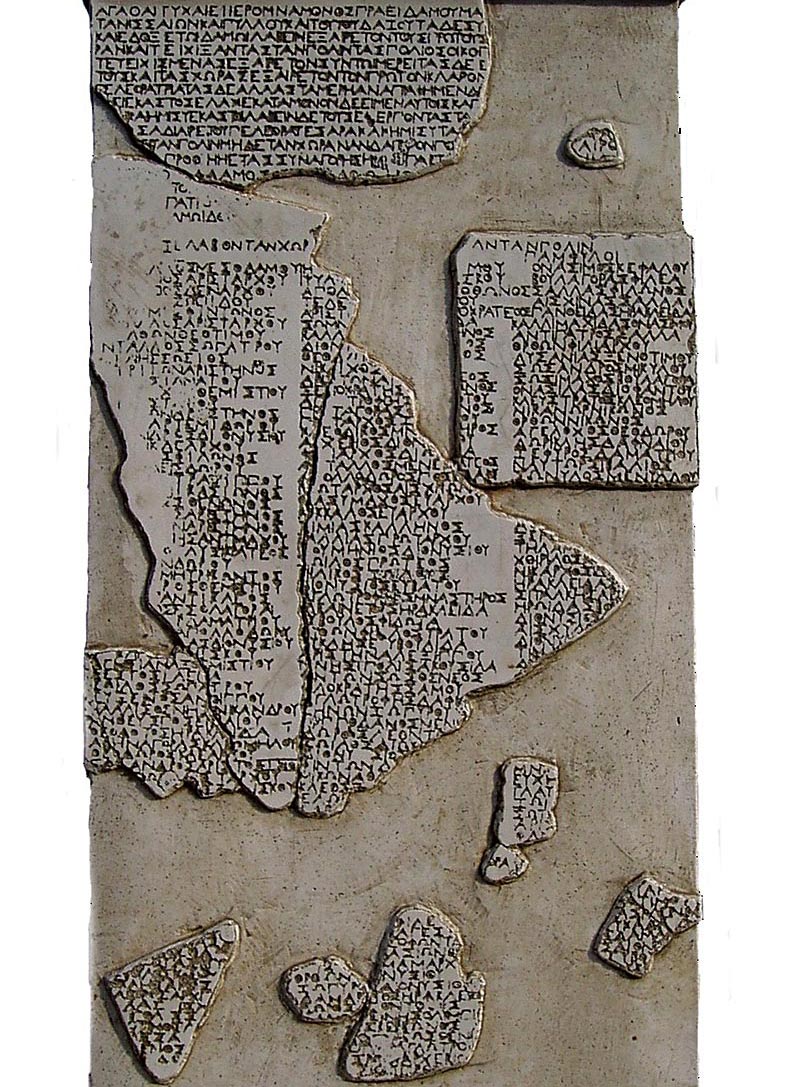
What is a Psephisma?
The word psephisma (Greek: ψήφισμα) refers to a decree or resolution arrived at by voting in an ancient Greek assembly. The term comes from psephos — the small stone or pebble that Greek citizens cast as a vote. A psephisma was the formal record of a democratic decision, the equivalent of a modern parliamentary resolution. The Lumbarda Psephisma is therefore not just a historical document — it is evidence that a functioning Greek democratic assembly operated on this island more than 2,300 years ago.
What the Tablet Says
The tablet is about one metre high, 13 centimetres thick and made of reddish-brown limestone, surmounted by a triangular decorative panel. The inscribed text is 69 centimetres wide and consists of two distinct parts.
The first part records the decisions of an assembly concerning the founding of a colony and the division of land between new settlers. The second part lists the names of the colonists and the specific land parcels allocated to each. Together they constitute a formal legal document — a contract between the Greek settlers and the local Illyrian population, specifically naming two Illyrian representatives: Pilos and his son Daz.
The full title given to the document by scholars is the “Decree of Issa concerning a colony on Korkyra Melaina” — Korkyra Melaina being the Greek name for Korcula, meaning Black Korkyra, a reference to the island’s dense dark Mediterranean vegetation. The colonists who came to Lumbarda were Greeks from Issa — today’s island of Vis — who had already established themselves elsewhere in the Adriatic and were now extending their reach further south.
The Greeks on Korcula
The Lumbarda colony was not the first Greek settlement on Korcula. An earlier colony had already been established on the western side of the island by settlers from Knidos — a city on the coast of what is now Turkey. By the time the Lumbarda Psephisma was written, Korcula already had a known Greek presence, and the island had emerged from historical obscurity to become a named point on the Greek understanding of the Adriatic.
The Lumbarda colony was founded in the 3rd century BC — possibly the late 4th — during a period of Greek expansion into the Adriatic. The sandy fields of Lumbarda, unusual on an island otherwise dominated by limestone, would have been recognised immediately as valuable agricultural land. The same sandy soil that today grows Grk grapes almost certainly attracted the Greek settlers in the first place.
What happened to the colony after its founding is largely unknown. The settlement described in the Psephisma has left almost no other trace. No significant ruins have been found, no further documents from the colony survive. The tablet outlived everything and everyone it recorded — which is precisely what makes it so remarkable as a historical source.
Popular Routes: Split to Korcula, Korcula to Split, Dubrovnik to Korcula, Korcula to Dubrovnik
Discovery and Significance
The tablet was found in 1877 in the ruins of ancient water cisterns on the hill of Koludrt, above the modern village of Lumbarda. It had survived more than two millennia in the ground, preserved by the dry limestone environment. Since its discovery, it has been studied by Croatian and international scholars and is widely cited in academic literature on Greek colonisation of the Adriatic and on ancient land distribution practices.
Its significance extends beyond Croatian history. The Psephisma is one of very few surviving documents in the ancient world that records in detail how a Greek colony was established and how land was divided between settlers — making it valuable to historians of ancient Greece, Roman land law and early urban planning. For Croatian geodesists and legal historians, it is also significant as the oldest known document about land distribution on Croatian territory.
It is classified as the oldest written document ever found in Croatia — a title it has held since its discovery and continues to hold today.
Where to See It
The original Lumbarda Psephisma is kept at the Archaeological Museum in Zagreb — Croatia’s national archaeological collection. It is not on display in Lumbarda or Korcula Town, which surprises many visitors who expect to find it closer to where it was discovered.
A replica and information about the Psephisma can be found at the Korcula Town Museum in the Old Town. The museum also displays gnathia vases found in graves from the same Greek period in Lumbarda — everyday objects that give context to the settlement described in the tablet. If you are visiting the Old Town, the museum is worth an hour of your time for this alone.
The hill of Koludrt where the tablet was found is above the modern village of Lumbarda — visible from the road but not formally signposted as an archaeological site. There is nothing to see at the discovery site itself, but knowing where it is adds something to the walk through the village.
The Psephisma and Grk Wine
The connection between the Psephisma and the Grk grape is more than circumstantial. The Greek settlers who came to Lumbarda almost certainly brought vine cuttings with them — as Greek colonists consistently did throughout the Mediterranean. The sandy fields they chose for their settlement are the same fields where Grk grows today. Whether the Grk vine is directly descended from those Greek introductions or is a native variety that predates the colony remains debated, but the two stories are intertwined in ways that make both more interesting.
When you walk through the Grk vineyards between Lumbarda village and Vela Pržina beach, you are walking through land that was formally divided and allocated by a Greek assembly more than 2,300 years ago. The tablet recording that division is in Zagreb. The vines growing on that land are still there.
Related Pages
- Psephisma – additional info
- Lumbarda village guide — history, beaches, wine and accommodation
- Grk wine — the ancient grape variety grown in Lumbarda’s sandy fields
- Vela Pržina beach — the sandy beach at the end of the ancient vineyard fields