Grk Wine Lumbarda – The Rarest Wine in Croatia, Grown Only on Korcula
Grk is a white wine grape grown nowhere else in the world except the sandy fields around Lumbarda on the eastern tip of Korcula island. Not anywhere else in Croatia – nowhere else on earth. The total cultivated area is less than 50 hectares, the number of producers is small, and the wine it makes is genuinely rare. Most visitors to Korcula walk past Grk vineyards on the way to Vela Pržina beach without knowing what they are looking at. This page explains what makes Grk so unusual, what the wine tastes like, and where to try it.
What is Grk?
Grk (pronounced Gerk) is an indigenous white grape variety found exclusively in Lumbarda, Korcula. The name has two competing explanations — it either derives from the Croatian word for Greek (Grk), reflecting the belief that Greek settlers brought the vine to the island around 400 BC during the Hellenistic period, or it comes from the Croatian word for bitter, describing the wine’s characteristic aftertaste. Both may be partly true.
Genetic research has complicated the Greek origin story somewhat — DNA analysis has shown Grk to be a relative of Tribidrag, an ancient Croatian variety also related to Zinfandel, suggesting it may be indigenous to the eastern Adriatic rather than imported from Greece. The debate continues among ampelographers. What is not in dispute is that Grk is one of the oldest cultivated grape varieties in Croatia and that its survival into the modern era is something of an accident of geography.
Why Grk Only Grows in Lumbarda
Two things make Lumbarda the only place in the world where Grk successfully produces fruit — the soil and the vine’s unusual biology.
The sandy soil of Lumbarda is exceptional on an island otherwise dominated by limestone and clay. The same sandy terrain that makes Lumbarda’s beaches unusually soft and fine also creates growing conditions that Grk appears to require. The sandy topsoil drains quickly, stays warm, and provides the low-nutrient stress environment in which the variety thrives. Attempts to cultivate Grk on different soils — including elsewhere on Korcula — have produced poor results.
The second factor is more unusual. Grk has only female functional flower parts — it cannot self-pollinate. This makes it one of a tiny number of grape varieties in the world — less than 1% — that cannot reproduce without another variety planted alongside it. In Lumbarda, Plavac Mali is traditionally grown between the Grk rows as a pollinator. This means every Grk vineyard also contains a red grape variety, a practical necessity that has shaped the look of the landscape for centuries.
The combination of unique soil and biological dependency on a pollinator makes Grk essentially impossible to replicate elsewhere. This is not marketing — it is an agricultural reality that makes the wine genuinely singular.
How Grk Survived Phylloxera
In the late 19th and early 20th centuries, the phylloxera louse devastated vineyards across Europe, destroying most of France’s and Italy’s vine stock and much of Croatia’s. Lumbarda’s Grk survived because phylloxera cannot thrive in sandy soil — the louse needs clay-rich earth to complete its life cycle. The same sandy terrain that defines Grk’s growing conditions inadvertently protected it from the outbreak that wiped out its counterparts elsewhere. It is one of the few places in Europe where pre-phylloxera vines survived on their own roots.
Popular Routes: Split to Korcula, Korcula to Split, Dubrovnik to Korcula, Korcula to Dubrovnik
What Grk Tastes Like
Grk is a dry white wine with high acidity and a distinctive character that sets it apart from other Croatian whites. The nose typically shows citrus — lemon, grapefruit — with stone fruit notes of peach and apricot underneath. On the palate it is crisp and refreshing with a mineral quality that some tasters describe as slightly briny, as though the vines have absorbed something of the sea air from the nearby coast. The finish has a characteristic slight bitterness — not unpleasant, more like a clean dryness — which may be the origin of the name.
It is best served well-chilled and pairs well with seafood — grilled fish, oysters, shellfish — which makes it an ideal match for a meal in Lumbarda after a morning on the beach. Some producers also make a Grk Prošek — a traditional Dalmatian dessert wine — and sparkling versions, though the dry still wine is the most common and the one worth seeking out first.
Grk Wineries in Lumbarda
There are around eight producers of Grk in Lumbarda — a small number reflecting the limited cultivated area. The most established and widely known is Biré Winery, which produces a Grk with notable citrus on the nose and hints of seagrass and stone fruit — dry but expressive, with the characteristic mineral finish. Žure Winery and Čipre Winery are two other producers worth seeking out in the village.
Most wineries in Lumbarda welcome visitors for tasting, particularly in summer. The experience is informal — a table in a courtyard or cellar, a glass or two poured by the family who made it, conversation about the vines and the vintage. Wine tourism in Lumbarda has grown in recent years and guided vineyard walks and tasting experiences are now available for those who want more structure. Ask at your accommodation or at the tourist office in Korcula Town for current recommendations.
One producer worth noting outside Lumbarda: Black Island Winery in Smokvica has begun cultivating Grk inland under the Radovanović label, crafted by winemaker Igor Radovanović. The difference between the Lumbarda coastal vineyards and the inland Smokvica terroir produces a subtly different wine — interesting for comparison tasting if you have time.
Grk vs Pošip – Korcula’s Two Great Whites
Korcula is known for two indigenous white wines — Grk and Pošip — and visitors often ask which to try. They are quite different:
- Grk — grown only in Lumbarda, high acidity, citrus and mineral character, slight bitterness on the finish. Rare, produced in small quantities, best with seafood.
- Pošip — grown in the central villages of Cara and Smokvica, fuller-bodied, notes of apricot and almond, rounder and more approachable. The first Croatian white wine to receive protected designation of origin status. Easier to find and more widely exported.
If you are on Korcula for more than a day, try both. A glass of Grk in Lumbarda and a glass of Pošip in Cara or Smokvica on the same day gives you a complete picture of what makes Korcula’s wine identity genuinely distinctive on the Adriatic.
The Vineyards – What to Look For
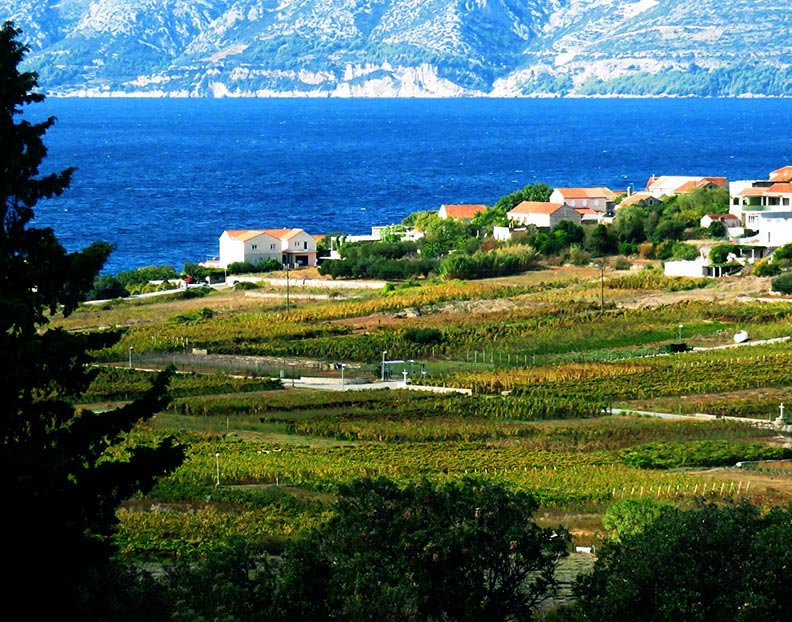
Walking through the Lumbarda vineyards is worth doing in its own right, not just as a route to the beach. The vines grow in long rows across the sandy fields between the village and Vela Pržina — an easy 20-minute walk with sea views opening up as you descend towards the coast. Look for the alternating rows of green-leaved Grk vines and the darker Plavac Mali planted alongside them. In late summer, September and early October, the harvest is underway, and the smell of fermenting juice drifts from the cellar doors.
The landscape here is genuinely unusual for Dalmatia — sandy fields rather than the typical limestone and scrub of most Croatian islands. The combination of sandy soil, Mediterranean light, sea views and rows of ancient vines makes the Lumbarda vineyard walk one of the more distinctive short walks on the island.
An Almost Endangered Variety
Grk is classified as almost endangered by Croatia’s State Institute for Nature Protection. As of the most recent data, fewer than 15-50 hectares of Grk vines are cultivated in total — the entire world supply fits within a few fields around a small Adriatic village. Younger generations have not always continued the labour-intensive cultivation, and the pollination dependency makes it harder to grow than most varieties. The wine’s growing international reputation and the development of wine tourism in Lumbarda have helped reverse some of the decline, but Grk remains genuinely rare in a way that most “rare” wines are not.
When you drink a glass of Grk in Lumbarda, you are drinking something with a 2,500-year history on this particular stretch of coast. That is worth knowing before you order.
Related Pages
- Lumbarda village guide — beaches, accommodation, restaurants and things to do
- Vela Pržina beach and Bilin Zal, the sandy beaches at the end of the vineyard walk
- All Korcula beaches — complete guide to beaches around the island