Čara, Korcula – Wine Country, Španić Kaštel and Čarsko Polje
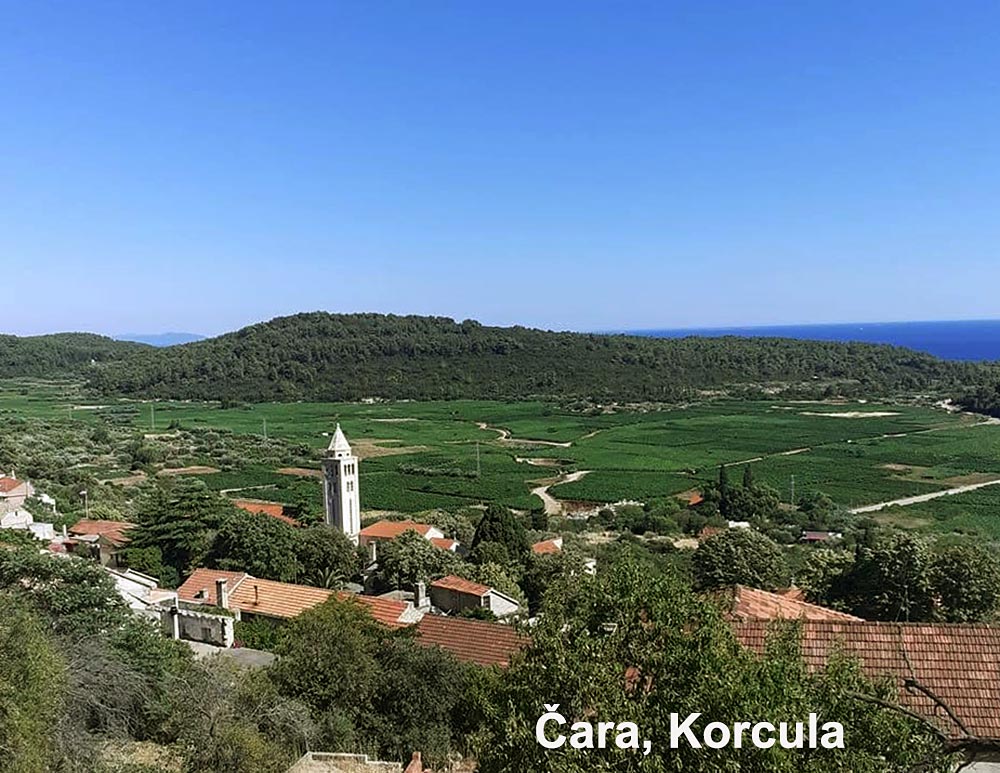
Čara is a wine village of around 600 people on the south slope of the central hills of Korcula, about 25 kilometres from Korcula Town along the main island road. Below the village spreads Čarsko Polje – a large, fertile plain covered in Pošip vineyards that is one of the most beautiful agricultural landscapes on the island and one of the two fields (the other being Smokvičko Polje to the west) responsible for producing most of the world’s Pošip wine. Čara is a quieter, less visited village than its neighbour Smokvica – it has no winery walk and no monument, just the vineyards, the fortified Španić Kaštel at the village entrance, a 14th-century church with a remarkable story, and the coastal settlements of Zavalatica and Žitna a short drive below.
History and the Name
Čara is one of the oldest settlements on Korcula island. The name itself may be of ancient Greek origin – the field below the village, Čarsko Polje, is believed by some scholars to derive from a Greek word, reflecting the possibility that Greeks had a presence in this fertile valley long before the medieval village took shape. The Greeks established two colonies on Korcula – the earlier one in the 6th century BC on the western part of the island, and the later Lumbarda colony recorded in the Psephisma of the 3rd century BC – and Greek villas are believed to have existed on the island in the intervening period.
Christianisation of the village’s inhabitants is recorded from the 11th century, with a chapel dedicated to Saints Cosmas and Damian among the earliest documented structures. By the 14th century the village had its parish church and the votive church in the field below – both of which survive in modified form today. Like Smokvica, Cara grew in the 15th and 16th centuries as refugees from Ottoman pressure on the mainland arrived on the island seeking safety.
The poet Petar Kanavelić – one of the most significant Croatian Baroque writers, born in Korcula Town in 1637 – used the coastal settlement of Zavalatica below Čara as his summer retreat. The promenade along the Korcula Town waterfront bears his name today.
The Španić Kaštel
The most striking building in Čara is the Španić Kaštel – a fortified stone house that stands at the entrance to the village on a steep hillside to the right as you arrive from Korcula Town. Built in 1674 and recently restored to its original 17th-century design after a seven-year reconstruction project, it is the best-preserved example of a Dalmatian fortified noble residence on the island.
The Kaštel’s history moves from military to domestic in an interesting sequence. It began as a small fortified outpost housing seven soldiers – a defensive position on the approach to the village during the period of Ottoman threat. After the threat diminished, the Španić family – wealthy landowners from Korcula Old Town who at one time owned the entire Čarsko Polje vineyards – converted it into their summer residence. The family coat of arms and a Latin inscription recording the laying of the foundation stone are visible on the south-west wall, overlooking the sea and the vineyards below.
The views from the Kaštel’s position are among the best from any building in a Korcula village – across the full sweep of Čarsko Polje to the Adriatic, with Lastovo on the horizon on clear days and the outline of Monte Gargano on the Italian coast visible in exceptional visibility. The house is now available as holiday accommodation – a rare opportunity to stay in a genuinely historic building with the vineyards at your door.
Čarsko Polje and Pošip
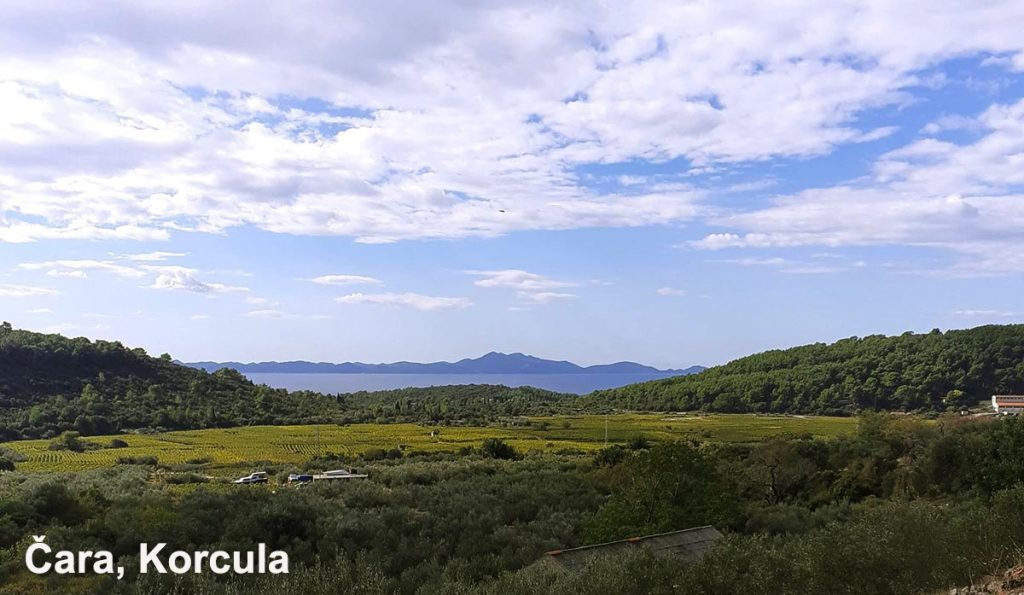
The field below Čara – Čarsko Polje – is one of two plains on Korcula responsible for Pošip wine, the other being Smokvičko Polje to the west. Together they form the Smokvičko-Čarsko Polje growing area – the only place in the world where Pošip is cultivated at scale. The landscape of the field in summer, with rows of Pošip vines stretching across a flat, sun-filled plain backed by the village on the hillside above and the coast visible in the distance, is genuinely beautiful and worth pausing to appreciate rather than simply driving through.
Popular Routes: Split to Korcula, Korcula to Split, Dubrovnik to Korcula, Korcula to Dubrovnik
The Pošip cooperative cellar sits in Čarsko Polje below the village, on the road towards Zavalatica and Žitna. PZ Pošip Čara is one of the oldest Pošip producers on the island, producing wine from the grapes of the Čara growers alongside its Smokvica counterpart. Wine tasting at the cellar is possible – check locally for current visiting hours as these change by season. Several family producers in Čara also welcome visitors independently.
Notable family wineries in Čara include Krajančić, Nerica and several smaller producers. The wine sold directly from Čara producers – sometimes poured from the tank rather than a bottle – reflects the village’s own terroir, which differs subtly from the Smokvica side of the field due to slight differences in elevation and soil composition.
The Walk Through Čarsko Polje
The most rewarding way to experience Čarsko Polje is on foot rather than by car. A walk from the village down through the vineyards and olive groves of the field, passing the old church of Gospa od Čarskog Polja and the wine cellar, takes about an hour at a relaxed pace and gives a ground-level perspective on the vineyard landscape that the road does not provide. The path continues to the southern coast at Zavalatica and Žitna – combining the walk with a swim and lunch is a natural half-day combination.
The Church of Our Lady of Čara Field – and the Alabaster Reliefs
In the middle of Čarsko Polje, surrounded by vineyards, stands the church of Gospa od Čarskog Polja – Our Lady of Čara Field. The church dates from the 14th century and was remodelled in Baroque style in a later period. It contains one of the most remarkable objects in any church on the island: a predella – a decorative panel – with alabaster reliefs depicting scenes from the life of the Virgin, originally coloured and now white with age.
The reliefs are of English origin, from a 15th-century workshop in Nottingham. How they came to be in a small church in the middle of a Dalmatian island vineyard is the subject of a local legend: the sea washed them ashore at the nearby bay of Čavica Luka, where they were found and brought to the church. Whether the legend is literally true or a later embellishment, the reliefs are genuine Nottingham alabaster from the 15th century – a trade item that moved across medieval Europe in considerable quantities, and one of the few surviving examples of English medieval craft in Croatia. Worth seeing specifically if you visit the church.
Zavalatica and Žitna – The Coast Below Čara
The road from Čara descends south through the vineyards of Čarsko Polje to two coastal settlements: Zavalatica and Žitna. Both sit in sheltered pebble bays on the south coast, both have cafes and restaurants serving fresh fish and local wine, and both are considerably quieter than the main tourist beaches on the island. Zavalatica was historically the port through which Čara’s Pošip wine was shipped – the old loading pier is still visible. Today it is a small summer resort with apartments and a handful of restaurants.
Žitna bay, a short distance east, is similarly quiet – a pebble beach in a sheltered position with a small restaurant and accommodation. Both bays are good destinations for visitors wanting a beach day with excellent local food and wine, away from the busier spots on the island.
Things to Do in and Around Čara
- Walk Čarsko Polje – the vineyard walk from the village to the coast, passing the church and the wine cellar. About an hour to Zavalatica; combine with lunch and a swim.
- Visit the Španić Kaštel – the fortified 17th-century residence at the village entrance. Worth seeing from the outside for the architecture and the views even if not staying there.
- Wine tasting at the cooperative or family producers – Pošip from the Čara side of the field, tasted in the village where it was grown.
- Visit the church of Gospa od Čarskog Polja – specifically to see the English alabaster reliefs, one of the most unusual objects in any church on the island.
- Drive or cycle to Zavalatica and Žitna – the road through the vineyards is one of the more scenic short drives on the island. By bicycle from the village takes about 20 minutes downhill.
- Walk to Pupnat or Smokvica – Čara is well positioned for walking east to Pupnat or west to Smokvica along the island road and older paths through the hills. Allow 45-60 minutes in either direction.
Getting to Čara
By car from Korcula Town, the drive takes about 30 minutes along the main island road through Žrnovo and Pupnat. By bus, the regular cross-island service connecting Korcula Town to Vela Luka stops in Čara – from the bus stop the village centre and the wine cellar road are within walking distance. The drive from Smokvica takes about five minutes. From Čara, the road south to Zavalatica takes about 10 minutes through the vineyards.
Location Map
Related Pages
- Smokvica village – neighbouring wine village, birthplace of Pošip and home of the Pošip Walk
- Zavalatica – the coastal settlement below Čara, former wine export port
- Pupnat village – the next village east, gateway to Pupnatska Luka beach
- Pošip wine – full guide to Korcula’s most celebrated white wine
- All Korcula beaches – including Zavalatica and Žitna on the south coast
- Things to do on Korcula – complete activities guide for the island